Extraordinary speed for a wider range of applications
Pushing the boundaries of GDDR
As the first DRAM to feature PAM3 signaling, Samsung GDDR7 is a leap forward in computer graphics that can be leveraged in graphics cards, game consoles, automotive, HPC, and AI/ML. The 30% increase in speed and 20% improvement in power efficiency1 make it the ideal choice for numerous applications. And thanks to newly introduced package materials and an optimized circuit design, it offers enhanced reliability with a 70% decrease in thermal resistance. All of these advantages combine to make GDDR7 an essential solution for the AI era.
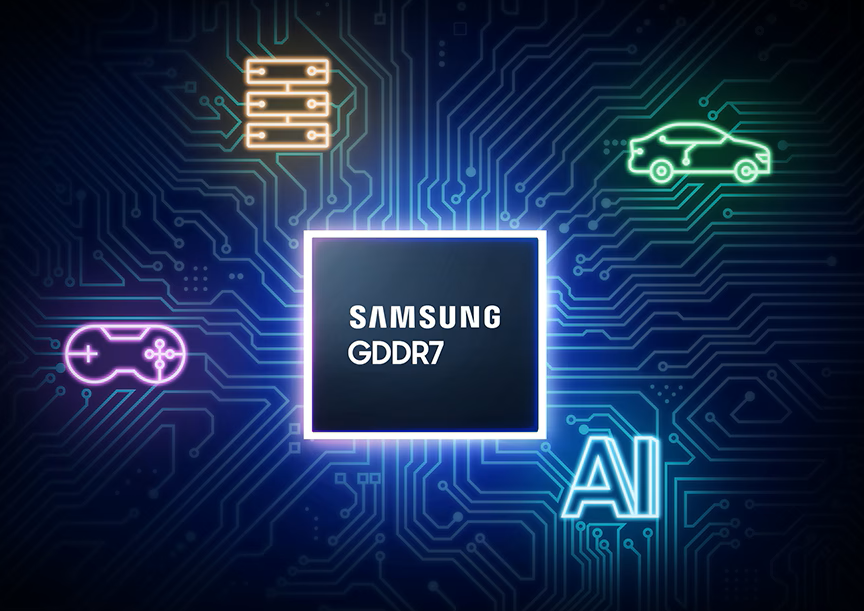
Speed and power efficiency metrics are in comparison to the GDDR7 predecessor, GDDR6.
Faster speed, enabled by PAM3
Samsung’s GDDR7 offers the fastest available performance of any standardized graphics memory product. This performance is made possible through the industry’s first application of PAM3 signaling2. PAM3 transmits 1.5 times more data in the same signal cycle than the conventional NRZ method 3, giving GDDR7 a 30% performance improvement over its predecessor.
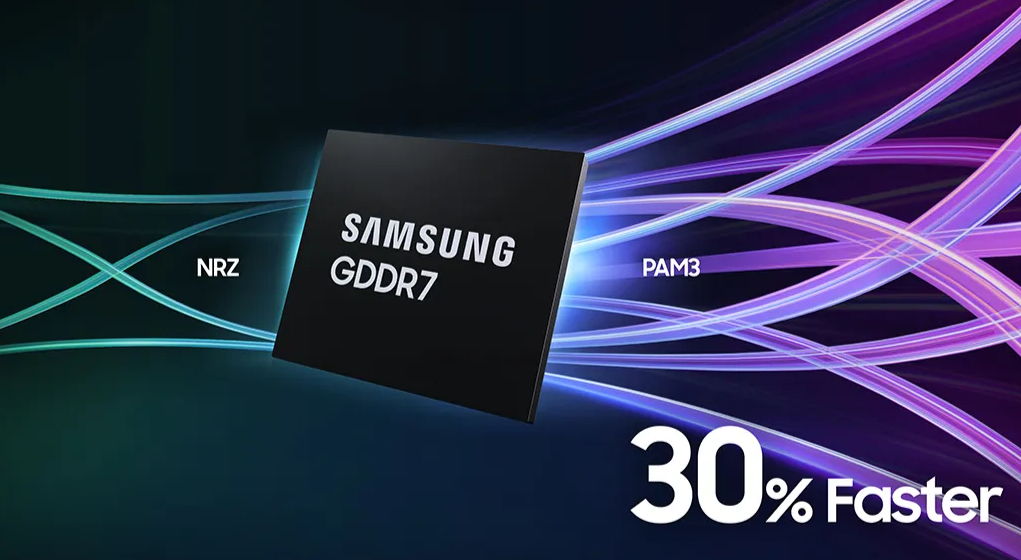
2 Pulse Amplitude Modulation 3 (PAM3) is a signal transmission technology.
3 Non return to zero (NRZ) modulation encodes data using two signal levels, while PAM3 uses three signal levels.
Optimized power usage, ensuring cost-effective operations
GDDR7 optimizes power, improving power efficiency by 20%. This type of optimization decreases standby power consumption by 50%, resulting in less power used overall. Less power being consumed means reduced costs, which contributes to lowering customers’ total cost of ownership (TCO).

Supreme stability
Benefit from higher reliability. GDDR7 achieves a 70% decrease in thermal resistance4 by using new package materials and an optimized circuit design. This allows it to avoid excessive heat generation, which prevents product degradation, performance loss and other potential hardware issues.
.png)
In comparison to the GDDR7 predecessor, GDDR6.